Improving efficiency in a premium hotel kitchen
Chewton Glen is a luxury country house hotel and spa on the edge of the New Forest. In a kitchen built around quality ingredients, seasonal menus, and high hospitality standards, operational efficiency matters just as much as creativity.
Executive Chef Luke Matthews and his team focus on preparing food to a high standard while managing fresh ingredients, prepared items, shelf life, and daily production needs. With seasonal ingredients playing an important role in the menu, the team needed a labeling workflow that could keep pace with availability, demand, and food safety requirements.
Handwritten labels can slow down a kitchen team and create inconsistency. When staff need to write product names, preparation times, and use-by dates manually, valuable chef time is spent on administration instead of food preparation.
The challenge: handwritten labels and variable shelf life
Chewton Glen needed a reliable way to label picked, prepared, and part-used food without relying on handwriting. The kitchen required labels that were clear, accurate, and consistent across different members of the team.
For a busy hospitality kitchen, incorrect or unclear labels can affect food rotation, food waste, and confidence in prepared items. If each label is written manually, there is more room for interpretation and more opportunity for human error.
The team wanted a process that would support food safety standards while reducing repetitive work and helping chefs spend more time on food quality.
The solution: automated date labeling
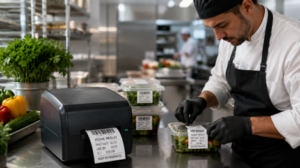
Chewton Glen implemented the Avery Dennison Freshmarx 9417+ automatic date labeling system. The solution allowed food items to be pre-set with the correct product identification, preparation time, and use-by date.
Instead of calculating and handwriting label details every time, the team could print accurate labels quickly. This helped create a standardized process for prepared food and part-used ingredients across the kitchen.
The system also reduced the chance of interpretation, because each label followed a consistent format and contained the right information for the product being labeled.
How Chewton Glen benefited
The automated labeling system helped the kitchen team improve consistency, reduce manual labeling time, and support food safety workflows with more confidence.
- Clearer labels for prepared and part-used food
- Reduced reliance on handwritten label information
- More consistent product identification and use-by dates
- Less time spent manually writing repetitive labels
- Reduced risk of errors when labels are handled by different staff
- Improved continuity across kitchen processes
- Better support for food safety standards
- Potential to reduce food waste through more accurate date labeling
Saving chef time and reducing waste
In a professional kitchen, small process improvements can have a meaningful impact. If chefs spend less time writing labels and checking dates manually, they can spend more time preparing food, managing ingredients, and maintaining quality.
Automated date labeling also helps teams manage food rotation more effectively. When prepared items are clearly labeled with production and use-by information, staff can make faster decisions and reduce uncertainty around shelf life.
This can help reduce unnecessary waste while giving the team greater confidence that food is being handled consistently.
Fast setup and simple training
One of the important advantages of the solution was ease of setup. The system could be configured around the kitchen’s requirements, including product information and label workflows.
The printer also supported a large number of product buttons and categories, giving the team flexibility as menus and preparation needs changed. This made it easier to create a labeling process that reflected the way the kitchen actually worked.
Because the system was structured and easy to use, training time was reduced. Staff could print the labels they needed quickly and accurately without a long learning curve.
Supporting consistency across food preparation
Consistency is critical in hospitality. Whether a label is printed during prep, service, or food storage, the information needs to be clear and reliable.
Automated labeling helped Chewton Glen maintain a consistent standard for identifying prepared food, recording preparation times, and managing use-by dates. This created a cleaner workflow for staff and a stronger process for food safety management.
Efficiency and effectiveness drive better kitchen economics
Kitchen efficiency is not only about speed. It is about using time, ingredients, and staff resources more effectively. By reducing handwritten labels, improving shelf-life accuracy, and supporting food rotation, automated labeling can help kitchens reduce waste and improve operational control.
For hotels, restaurants, catering teams, and commercial kitchens, the right date labeling system can help improve accuracy, save time, and create a more reliable food preparation workflow.
Southern Barcode helps food service businesses choose labeling systems, printers, labels, and automation tools that support real kitchen operations and measurable workflow improvements.