
Efficiency and consistency in a busy hotel kitchen
Chewton Glen is a luxury country house hotel and spa located on the edge of the New Forest. In a hospitality environment where food quality, guest experience, and kitchen efficiency all matter, clear food labeling plays an important role in daily operations.
For Executive Chef Luke Matthews and his team, the kitchen is more than a production space. It is where ingredients are prepared, organized, stored, labeled, and served with consistency. With seasonal menus and high-quality ingredients, the team needed a reliable way to identify prepared food quickly and accurately.
Manual handwritten labels can slow down a kitchen team and increase the chance of unclear or inconsistent information. In a busy hotel kitchen, that can affect food safety, shelf-life tracking, and the overall flow of service.
The labeling challenge
Chewton Glen needed a solution that could help the kitchen team label prepared and part-used food clearly without relying on handwriting. The goal was to reduce time spent writing labels manually while maintaining confidence in preparation times, product identification, and use-by dates.
In a fast-moving back-of-house environment, labels need to be easy to read, accurate, and consistent across different team members. When several people are handling prepared food and ingredients, automation helps remove uncertainty from the process.
The solution
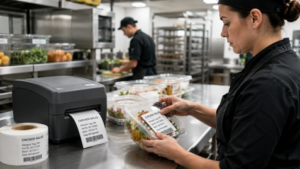
The hotel implemented an automated date labeling system designed for food preparation environments. The system allowed food items to be pre-set with product identification, preparation time, and use-by date information, helping the team produce consistent labels quickly.
Instead of spending valuable chef time writing labels by hand, the team could generate clear, legible labels for prepared food and ingredients. This helped support food safety standards while improving efficiency in the kitchen.
How Chewton Glen benefited
The automated labeling process helped the team improve consistency and reduce the risk of manual labeling errors. Food items could be clearly identified with the correct name, date, time of production, and use-by date.
- Clearer food preparation labels across the kitchen
- Reduced reliance on handwritten labels
- More consistent product identification and use-by date information
- Faster labeling for prepared and part-used food
- Improved continuity across kitchen processes
- Greater confidence in food safety workflows
The system also made it easier for different staff members to follow the same process. With preloaded information and automated date labeling, the kitchen team could print the labels they needed quickly and accurately.
Supporting food safety and kitchen productivity
Food labeling is not only about organization. In hospitality, it supports safer operations, clearer communication, and better control over prepared food. When labels are legible and consistent, kitchen teams can work with more confidence.
For Chewton Glen, automated labeling helped the team spend less time on repetitive manual administration and more time focusing on food quality, kitchen productivity, and the guest experience.
A smarter approach to hospitality labeling
This case study shows how automated food labeling can support busy hospitality teams by improving accuracy, reducing repetitive manual work, and creating a more reliable labeling workflow.
For hotels, restaurants, and food service operations, the right labeling system can help protect standards while giving teams a faster and clearer way to manage prepared food.