Why BPA-free thermal labels matter
Direct thermal labels are used every day across food service, retail, logistics, healthcare, warehousing, and general business operations. They are convenient because they do not require ink, toner, or ribbons. Instead, the printed image is created when heat from the printhead reacts with the thermal coating on the label material.
For many years, Bisphenol A, commonly known as BPA, was used in some thermal paper and label materials as a color developer. This helped the printed image appear when the material was exposed to heat. However, concerns around BPA exposure and changing regulations have led many businesses to review the types of thermal labels they use.
The original Southern Barcode article highlighted that European Union rules restricted the placing on the market of thermal paper containing BPA at a concentration equal to or greater than 0.02% by weight after January 2, 2020. This affected thermal materials commonly used in applications such as receipts and food labels.
Where thermal labels are commonly used
Thermal labels are found in many daily business workflows. They are often used because they are fast to print, easy to scan, and available in a wide range of sizes, adhesives, and material options.
- Food preparation and date labeling
- Grab-and-go food labels
- Retail price labels and shelf labels
- Shipping and logistics labels
- Warehouse and inventory barcode labels
- Healthcare and laboratory labels
- Visitor badges and temporary identification labels
Because these labels may be handled by staff, customers, delivery teams, and end users, many organizations prefer to choose label materials that better align with their safety, compliance, and sustainability goals.
The difference between direct thermal and thermal transfer labels
When choosing labels, it is important to understand the difference between direct thermal and thermal transfer printing.
Direct thermal labels use a heat-sensitive coating. They do not require a ribbon, which makes them simple and cost-effective for short-term applications such as receipts, food date labels, shipping labels, and temporary barcode labels.
Thermal transfer labels use a ribbon to transfer ink onto the label surface. This can be a better option when labels need to last longer, resist abrasion, handle tougher environments, or remain readable over an extended period.
BPA-free options are especially relevant for direct thermal materials because the coating chemistry is part of what creates the printed image.
Why businesses move to BPA-free label materials
Moving to BPA-free thermal labels can help businesses reduce uncertainty around label chemistry while maintaining the speed and convenience of direct thermal printing.
- Supports safer label handling practices
- Helps align label purchasing with changing regulatory expectations
- Provides peace of mind for food service, retail, and customer-facing workflows
- Maintains the convenience of direct thermal printing
- Can support internal sustainability and product safety initiatives
- Helps standardize consumables across multiple locations or departments
For businesses that print high volumes of labels, even a small consumables decision can affect purchasing consistency, operational confidence, and customer perception.
Choosing the right BPA-free thermal label
The right label depends on the printer model, label size, adhesive, application, environment, and how long the label needs to remain readable. A food preparation label may need a different adhesive and face material than a warehouse barcode label or a retail shelf label.
When reviewing BPA-free thermal labels, businesses should consider:
- Printer compatibility
- Label roll size and core size
- Label dimensions and layout
- Adhesive type
- Expected label lifespan
- Exposure to moisture, cold storage, handling, or abrasion
- Barcode readability and print quality
- Food service, retail, logistics, or warehouse requirements
Selecting the correct consumable helps prevent printing issues, poor adhesion, unreadable barcodes, and unnecessary waste.
Supporting food service and retail operations
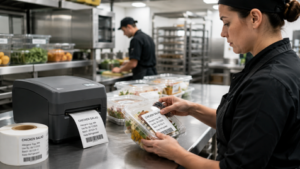
BPA-free thermal labels are especially useful for businesses that use labels in customer-facing or food-related environments. Restaurants, hotels, cafés, grocery stores, convenience stores, and food preparation teams often need labels that are easy to print, easy to read, and suitable for fast-paced workflows.
In these environments, labels may be used for preparation dates, use-by dates, product names, ingredients, pricing, and barcode scanning. Clear and reliable labels help teams work faster while supporting better organization and communication.
A better consumables strategy
Switching to BPA-free thermal labels is not only about replacing one label roll with another. It is an opportunity to review how consumables are being used across the business.
Southern Barcode can help businesses identify the right BPA-free direct thermal labels for their printers, applications, and operational requirements. Whether the need is food labeling, retail pricing, logistics, inventory tracking, or general barcode printing, the right label material can improve reliability and support a cleaner labeling workflow.